

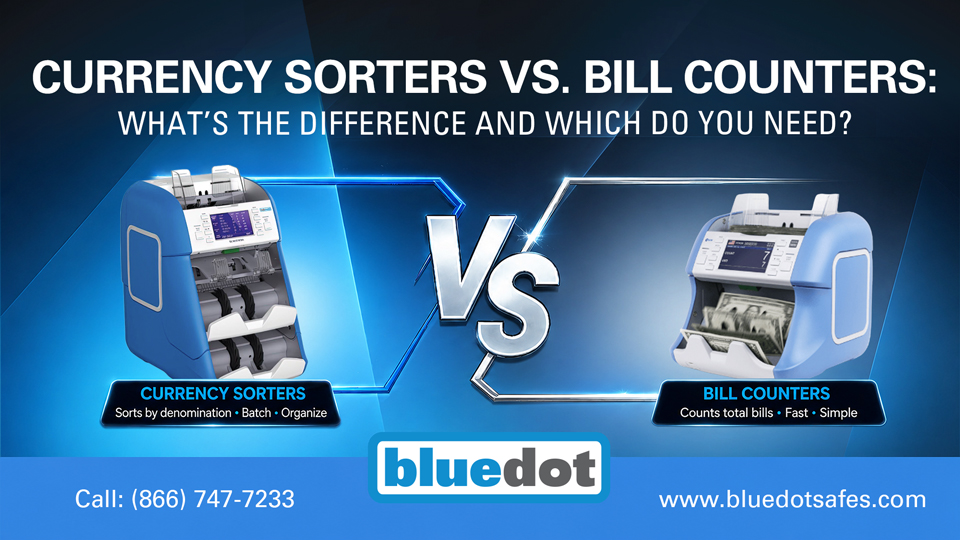
Currency Sorters vs. Bill Counters: What’s the Difference and Which Do You Need?
Currency Sorters vs. Bill Counters: What’s the Difference and Which Do You Need?

Handling cash accurately and efficiently is essential for businesses that process daily deposits. Whether you’re managing a retail store, bank branch, hospitality venue, or other cash-intensive operation, choosing the right cash counting equipment can improve workflow and reduce manual errors.
While the terms bill counter and currency sorter are sometimes used interchangeably, they serve different purposes. Understanding those differences can help businesses make informed purchasing decisions while strengthening overall cash handling procedures.
At Blue Dot Safes, we help customers choose security solutions designed for real-world risks—not assumptions.
💵 1. What Is a Bill Counter?
A bill counter is designed to quickly count stacks of banknotes of the same denomination.
Bill counters are commonly used when:
- 💰 Counting cash drawers at the end of a shift
- 🏦 Preparing deposits with pre-sorted bills
- ✔ Verifying counted cash before storage
- ⏱️ Reducing manual counting time
A standard bill counter increases efficiency but generally assumes that all notes in the stack have the same value.
For businesses with straightforward cash handling needs, this may be all thats required.
🏦 2. What Is a Currency Sorter?
A currency sorter performs more advanced processing by identifying and organizing mixed-denomination banknotes.
Depending on the model, currency sorters may:
- 📂 Separate different denominations
- 🧮 Calculate the total cash value
- 🔍 Detect suspect or damaged notes
- 📤 Sort bills into designated output pockets
These capabilities are especially valuable for organizations that receive large volumes of mixed cash throughout the day.
By reducing manual sorting, businesses can improve efficiency while minimizing counting errors.
⚖️ 3. Which Businesses Benefit from Each?
The right choice depends on your daily cash volume and operational requirements.
A bill counter may be suitable if you:
- 💵 Handle relatively low to moderate cash volumes
- 📦 Count pre-sorted bills
- ⚡ Need faster cash reconciliation
- 📋 Have simple deposit procedures
A currency sorter may be a better fit if you:
- 💰 Receive mixed-denomination cash
- 🗄️ Process multiple cash drawers daily
- ⏱️ Require faster end-of-day reconciliation
- 📊 Need stronger reporting and audit support
Selecting equipment that matches your workflow helps avoid unnecessary complexity while improving operational efficiency.
🔐 4. Cash Counting Is Only Part of the Security Process
Accurate cash counting is important, but protecting cash after it is counted is equally critical.
Businesses should also evaluate:
- 📥 Depository Safes for secure cash deposits during business hours
- 🏢 TL-15 and TL-30 Rated Safes for higher-risk cash storage environments
- 🛡️ High Security Safes where additional burglary resistance is required
- 🔩 Professional concrete anchoring to reduce the risk of safe removal
Combining efficient cash processing with secure storage creates a stronger overall cash handling strategy.
📋 5. Why Audit Trails Matter
As cash volumes increase, maintaining accountability becomes increasingly important.
Well-designed cash handling procedures should include:
- 📊 Consistent reconciliation processes
- 🔐 Employee access controls
- 📝 Documented deposit records
- ✔ Routine cash audits
- 👥 Clear separation of responsibilities
When businesses combine accurate counting with organized recordkeeping, discrepancies are often easier to identify and investigate.
These practices may also support internal controls and insurance documentation.
🛠️ 6. Choosing the Right Solution for Long-Term Operations
When evaluating cash handling equipment, consider more than speed alone.
Questions to ask include:
- 💰 How much cash is processed each day?
- 📂 Are mixed denominations common?
- 👥 How many employees handle cash?
- ⚡ Is faster reconciliation needed?
- 📋 Does the current workflow support accountability?
- 🔒 How will counted cash be secured after processing?
Choosing equipment that fits your operation today—and can continue supporting future growth—helps improve efficiency without creating unnecessary complexity.
✅ Cash Handling Equipment Evaluation Checklist
Before selecting a cash counting solution, consider the following:
- ✔ Estimate your average daily cash volume
- ✔ Determine whether cash arrives pre-sorted or mixed
- ✔ Review your reconciliation process
- ✔ Strengthen access control procedures
- ✔ Secure counted cash in an appropriate safe
- ✔ Verify professional installation and concrete anchoring where required
- ✔ Review insurance and compliance expectations
- ✔ Schedule regular maintenance for cash handling equipment and safes
🤝 Why Businesses Trust Blue Dot Safes
Effective cash handling extends beyond counting money—it requires secure storage, controlled access, and thoughtful planning.
Blue Dot Safes helps businesses evaluate security solutions that support reliable cash management, including:
- 📥 Depository Safes
- 🛡️ High Security Safes
- 🔥 Fire & Burglary Safes
- 🏢 TL-15 and TL-30 Rated Safes
- 🔒 Dormakaba locking solutions
Our team provides guidance on product selection, professional delivery, installation planning, anchoring considerations, and long-term security strategies that align with operational requirements, compliance objectives, and insurance expectations.
🔎 Final Thoughts
Both bill counters and currency sorters play valuable roles in modern cash handling operations. The right choice depends on your transaction volume, workflow complexity, and reporting needs.
Regardless of which solution fits your business, cash counting should always be paired with secure storage, controlled access, and well-defined procedures. A comprehensive approach helps improve efficiency while supporting long-term asset protection.
🔒 Talk to a Blue Dot Safes Specialist
If you are evaluating your current safe or planning an upgrade, our team is here to help.
📞 Call us at (866) 747-7233
📧 Email: [email protected]
🌐 Visit: bluedotsafes.com
Built in America. Trusted by professionals. Secure by design.


